


Introduction
There have been changes in the field of recruitment over recent years. Traditionally, recruitment involved a lot of paperwork, manually conducted screening of resumes, and physical interviews of job seekers. Nowadays, companies implement innovative technologies to make their recruiting process more effective and productive.
The role of digital transformation in this matter can hardly be underestimated. With the implementation of artificial intelligence (AI), automation technologies, virtual interviewing tools, and applicant tracking systems, recruitment teams are becoming increasingly digitized. Such innovations not only allow saving time on routine tasks but also help recruiters to identify suitable candidates faster.
In the context of growing competition in the talent market, organizations tend to pay more attention to their candidates’ experience, decrease the duration of the hiring process, and optimize their recruitment decisions. The role of digital transformation in helping recruiters to reach those goals is discussed below. This blog article is devoted to changes in the recruiting industry related to digital transformation.
Understanding Digital Transformation in Recruitment
The concept of digital transformation in the field of recruitment involves the employment of digital technologies to streamline and transform the hiring process. This implies the adoption of technology solutions to substitute conventional recruitment approaches and enhance the speed and accuracy of the process. Some of the digital technologies being adopted by recruitment professionals include ATS, recruitment software, artificial intelligence screening systems, assessments, recruitment analytics, and video interviewing platforms. Digital transformation in recruitment also entails changes in how recruiters operate.
Apart from using software applications, it involves changes in recruitment processes, recruitment team interactions, decision-making procedures, and many other aspects.
Why Recruitment Teams Are Adopting Digital Transformation
The job market is highly competitive nowadays. It takes an enormous amount of time to process thousands of resumes received by organizations for the same position.
Recruitment professionals adopt the concept of digital transformation since it enables them to:
- Cut the hiring cycle time
- Boost hiring precision
- Process a large number of resumes
- Ensure an excellent candidate experience
- Save money on recruiting
- Increase communication and collaboration
- Hire based on data
The growing trend of working remotely has added another dimension to the adoption of digital hiring. Organizations tend to employ candidates residing in other cities and countries.
Major Ways Digital Transformation Is Changing Recruitment Teams
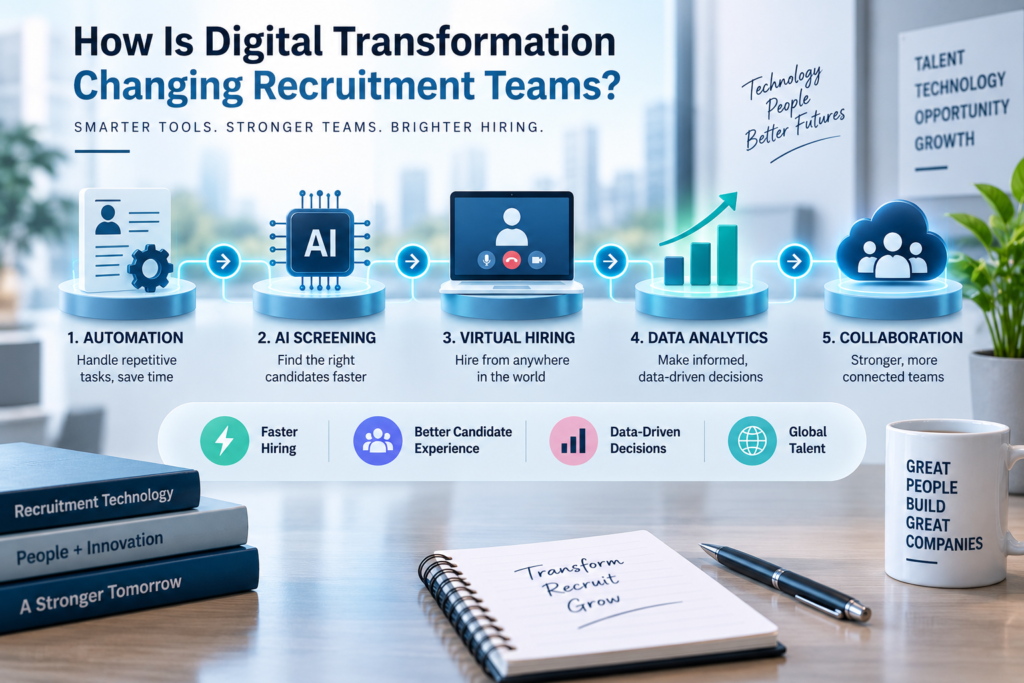
Automation of Repetitive Tasks
Recruitment automation is one of the most prominent consequences of digital transformation. Before automation, recruiters had to spend considerable time engaging in repetitive work such as interviewing schedules, resume screening, emailing, and record keeping.
Automated software programs take care of all of the aforementioned tasks automatically. This way, recruitment teams can dedicate more time to strategic tasks like talent engagement and talent acquisition.
For instance, automated e-mail programs are capable of sending out invitation and rejection e-mails to candidates automatically. Automated scheduling tools help in arranging the interviews.
AI-Powered Candidate Screening
Recruitment teams have been greatly impacted by Artificial Intelligence (AI). AI technology is capable of analyzing resumes and identifying potential employees who meet the job description.
Rather than having to go through hundreds of resumes manually, recruiters can use AI software to identify suitable candidates using factors like skills, experience, educational background, and specific keywords.
AI software used in recruitment is also effective in cutting down hiring times while increasing efficiency. Services such as IT Recruitment increasingly rely on AI-driven screening to match technical candidates faster.In some cases, certain AI software can even predict suitability through behavioral analysis.
While AI is efficient, human judgment still plays an important role.
Remote Hiring and Virtual Interviews
Digital transformation has enabled remote recruitment to be easier and more efficient. Virtual interviewing applications like Zoom, Microsoft Teams, and Google Meet have been widely adopted for recruitment purposes.
Organisations are able to conduct interviews of candidates in various locations without needing face-to-face interactions. This eliminates travel expenses as well as cuts down on the time taken to hire new people. Virtual recruitment also ensures that companies are not restricted in the pool of talent they are searching for. No longer are recruitment teams bound by geographical locations when recruiting new employees.This shift has fueled the rise of virtual staffing models that let companies build fully remote teams without compromising on quality.
Virtual assessment platforms and online onboarding platforms have streamlined the process even further.
Improved Communication with Candidates
Communication is essential in the process of recruitment. Slow or ineffective communication could lead to a bad impression on the part of the candidates. Various digital tools can assist recruiters in improving the process of communication with candidates. These include chatbots, automated emails, and candidate portals, among others. Candidates can check their application status, arrange interviews, and engage in communication with recruiters via online channels.
Good communication results in a good reputation for the employer among candidates.

Data-Driven Hiring Decisions
Recruitment teams of today’s time use recruitment analytics and evidence-based decision-making extensively.
Digital recruitment systems gather useful data in relation to recruiting performance, candidate behavior, sourcing performance, and recruitment costs. Recruitment teams can use the gathered data to refine their recruiting approach. For instance, recruiters may discover which websites produce the best-suited candidates or which recruitment phases are delaying the process. Evidence-based recruitment will help organizations make better decisions while being more efficient with the entire recruitment process.
Better Collaboration Among Recruitment Teams
Recruitment can be done by many departments, hiring managers, and human resource professionals. The use of digital recruitment platforms allows for easy collaboration among members in sharing information regarding candidates.
With cloud-based recruitment platforms, recruiting professionals and hiring managers will be able to access all the needed information regardless of where they are.
Collaboration will help eliminate any misunderstandings during the recruitment process.Many organizations now turn to recruitment process outsourcing (RPO) to centralize collaboration between internal HR teams and external recruiting partners.
Enhanced Employer Branding
In today’s world of recruiting, employer branding is an essential element. Candidates nowadays have the habit of checking out their potential employer on various social media sites before applying for a job vacancy.
Thanks to digital transformation, employers can effectively build their brand using social media channels, career websites, employee reviews, and digital marketing. Social media sites such as LinkedIn and Instagram are some of the digital platforms that employers use to enhance their employer brand image.
Benefits of Digital Transformation in Recruitment
Digital transformation comes with several advantages for recruitment departments and businesses.
These include, but are not limited to:
- Rapid hiring processes
- Good candidate experience
- Higher-quality hires
- Less paperwork
- Collaboration
- Global recruitment opportunities
- Recruitment analytics
- Lower recruitment expenses
- Scalability
By utilizing technology, the recruitment department will be able to perform its functions effectively without compromising on quality.
Challenges Recruitment Teams May Face During Digital Transformation
Even though there are many advantages to digital transformation, there are also certain challenges that may arise for recruitment teams.
Resistance to Change
Some staff members may be reluctant to use modern technology and recruiting methods.
Data Privacy and Cybersecurity Issues
Recruitment systems gather personal data from candidates. It is essential to implement proper cybersecurity policies.
Overreliance on Automation
An overreliance on artificial intelligence can often ignore human factors that play an important role in recruiting candidates.
Training Needs
Recruitment teams need appropriate training before implementing new technology.
Costs Related to Technology
The adoption of advanced recruitment technology may cost organisations significantly.
Nevertheless, despite such issues, most enterprises still consider digital transformation to be more advantageous than challenging.
Best Practices for Recruitment Teams Adopting Digital Tools
Certain best practices should be followed by recruitment teams to achieve digital transformation successfully.
Choosing the Appropriate Technology
Companies should choose the right recruitment tools according to their requirements.
Providing Adequate Training
Recruiters should be trained adequately to make effective use of digital recruitment platforms.
Preserving Human Touch
Human intervention is essential in digital recruitment, although it complements technology.
Focusing on Candidates
The process of digital recruitment should be user-friendly for candidates.
Evaluating Recruitment Performance Regularly
Recruiters should monitor recruitment performance through appropriate metrics.
The Future of Digital Recruitment
Recruitment will also be increasingly influenced by technological advancements in the coming years. The use of artificial intelligence, predictive analytics, machine learning, and automation is expected to make the process of recruiting employees much better.
These include:
- AI interviewing
- Predictive hiring analytics
- Virtual Reality screening
- Blockchain verification services
- Recruitment chatbots
On the other hand, qualities that are uniquely human will still be very critical during recruitment.
Successful recruitment teams will leverage both technology and human abilities to make the recruitment process highly effective.
Conclusion
The digital transformation process has greatly impacted recruitment teams and the whole recruiting process. Through the application of technology, organisations are being helped to achieve greater efficiency, minimise time lags in recruiting, offer better candidate experiences, and make better hires.
While issues such as data security, training, and resistance to change may pose some problems, there remains no denying that the advantages of digital transformation are making its adoption inevitable.
As technology advances, recruitment teams that embrace digital transformation will be better placed to attract and retain the best talent.
CTA
Want to learn more about business growth? Explore more here:
Frequently Asked Questions (FAQs)
What is digital transformation in recruiting?
Digital transformation in recruiting involves the adoption of digital tools and technology to streamline recruiting activities.
How does AI benefit recruitment teams?
AI benefits recruitment teams through automated resume filtering, identification of competent candidates, reduced recruitment period, and improved recruitment precision.
What are the advantages of digital recruiting?
The advantages of digital recruiting involve fast recruitment, positive candidate experience, enhanced communication, collaboration, decision-making, and lower recruiting expenses.
What difficulties do firms encounter during digital transformation in recruiting?
Difficulties that firms encounter during digital transformation include change management issues, data privacy, technology expenditure, learning requirements, and excessive automation.
Why is candidate experience crucial in digital recruiting?
Candidate experience is vital since it helps create good impressions about an organization and enhances its ability to attract quality employees.
