


Outdoor advertising was such a hassle over the decades, and only major brands with big pockets could engage in this practice. It entailed making phone calls with salespeople, tours of the location, big contracts, and the logistical nightmare of printing and installing vinyl. As a small business owner, you could easily see that renting a billboard was not a serious option.
This has been broken by the digital revolution. Businesses of all sizes today are able to purchase real-world outdoor advertising with a few clicks through programmatic digital out-of-home (DOOH) platforms. This physical advertisement infrastructure, coming together with digital convenience, is ensuring that outdoor advertisements are more convenient, more adaptable, and more data-driven than ever before.
The Vinyl vs. Pixels Evolution
The basis of this change is the digital billboard as such. Digital billboards unlike the old-fashioned types of billboards that used physical vinyl to replace the content, digital billboards are high-definition LED displays that can be changed immediately.
These screens originally belonged to large outdoor advertising companies whose only enhancement was a slight one: the advertisers were able to change the messages without printing expenses, but the process of buying them was manual. The actual breakthrough was programmatic technology. Based on automated systems applied in online display advertising, software platforms were developed to link advertisers with digital screen inventories, a marketplace where transactions occur in real-time.
Programmatic DOOH functions in the following way:
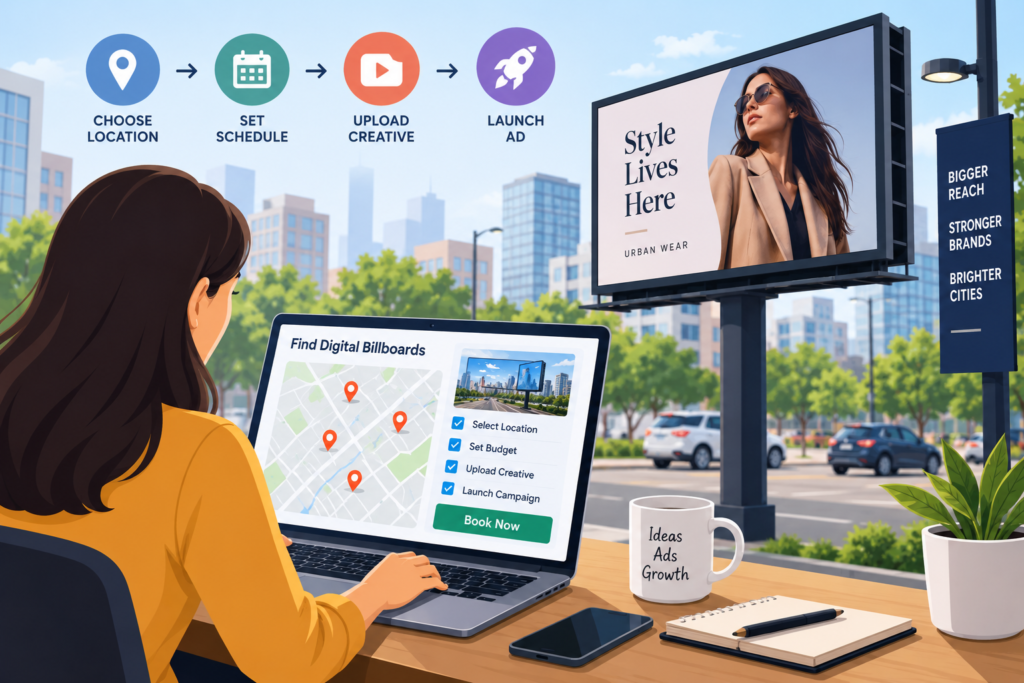
Purchase of a digital billboard on an online platform is run on an automated booking system. The simplified workflow is as follows:
- Demand-side Platform (DSP): This is the interface that is used by the advertiser. Platforms such as Vistar Media, Adomni, and Broadsign provide one with a chance to log in, see a map of screens to use, and provide a budget and creative material.
- The Auction: With the release of an advertiser campaign, the platform aligns its specifications (location, time, budget) with inventory. There is an automated transaction that takes place.
- The Display: The winning advertisement is transmitted digitally to the billboard, and it shows on the screen in a few minutes.
The sales intermediaries are removed through this automation, and the cost of entry and time to start a campaign is significantly reduced. Works that would have taken weeks to do can now be done in less than an hour.
Key Features of Digital Billboard Platforms
The new DOOH platforms have capabilities that present the advertiser with the same degree of control as they would get through the digital marketing mediums.
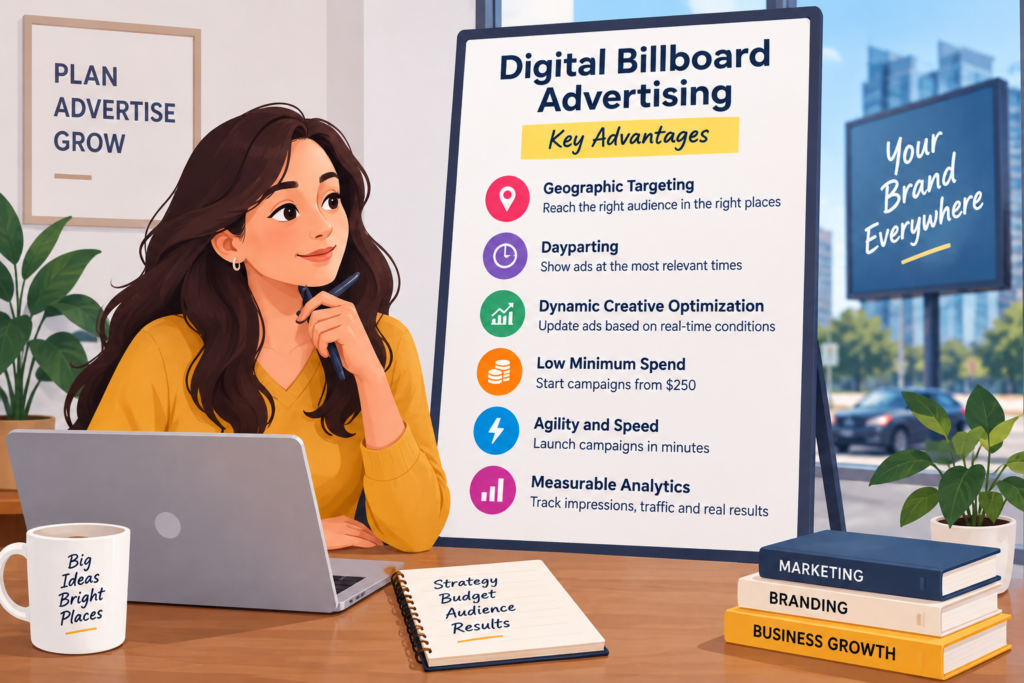
1. Geographic Targeting
Users are able to draw a radius on a map, or specific zip codes, or specific screens. The billboards that a restaurant chain can choose should be within a five-mile radius of their locations to attract local foot traffic instead of the chain spending its money on ineffective city-wide advertisements.
2. Dayparting
This is how advertisements are scheduled to be aired at a particular time of the day. This breakfast restaurant can only run its advertisement between 5:00 AM and 9:00 AM. A nightclub will be able to plan advertisements between 8:00 PM and 2:00 AM. This is to ensure that the ad spend is only done when the target audience is most relevant.
3. Dynamic Creative Optimization
Digital screens are able to transform, unlike the other static vinyl screens, depending on the external stimuli. A tire company can advertise wiper blades when it notices that there is rain, but use winter tires when it is cold. A retailer may integrate its billboard with its inventory system, where it automatically interrupts advertisements about out-of-stock products.
4. Advantages to Small and Medium Businesses
In the past, national brands dominated outdoor advertising. Democratization of the space has been through programmatic platforms, just as businesses can use professional recruitment services to build their teams efficiently.
5. Minimal spending threshold
Conventional billboard agreements used to demand investments of 5,000 to 20,000 dollars monthly. This barrier has been broken on online platforms. Most of them have campaigns that require as little as $250 and up to $500 to begin. Companies are able to purchase a billboard daily, for a few hours, or on a particular occasion, without having to engage in a long-term rental agreement.
6. Agility and Speed
When an entrepreneur has to promote an unexpected sale, he or she can log in to one of the platforms, place a “Sale Ends Today” creative, and within an hour, it will be on screens throughout the town. This flexibility could not be achieved in the days of vinyl printing.
7. Measurable Analytics
There are now well-developed analytics on the online platforms that did not exist before. During the campaign period, advertisers are able to view the estimated impressions (number of people who went past the screen), vehicles per day (counts of traffic), and in some instances, foot traffic lift to their physical store.
Modern digital billboards now come with sophisticated analytics that didn’t exist before. During a campaign, advertisers can track estimated impressions, daily vehicle traffic, and — in some cases — the lift in foot traffic to their store, giving a clear picture of how their digital billboard investment performed.
Selecting the appropriate Platform
Various platforms have become leaders, each possessing varying strengths.
- Adomni (currently Vistar Media): It is referred to as the easiest-to-use self-service platform. It enables any person with a credit card to purchase screens throughout the U.S. and is most convenient for novices and smaller companies.
- Vistar Media: A business-level solution with advanced data partnerships and an enormous programmatic marketplace. Agencies and national brands tend to make use of this.
- Broadsign: Provides the buying platform Broadsign Reach, which is an inventory aggregation of various owners. It is a great choice for the advertiser who wants to secure high-traffic, premium sites.
In selecting the platform, business owners ought to look at the availability of screens in the preferred geographical location, the lowest budget, and the presence of creative design assistance.
Challenges and issues
There are pitfalls to purchasing digital billboards online in spite of the convenience.
Creative Specifications
Digital billboards are considered at hundreds of feet on high speeds. Great contrast, big type (about 1 inch of letter height to every 10 feet of reading distance), and utter brevity are the key to effective design. The normal reading time of drivers on a billboard is 3-5 seconds. The majority of platforms will not accept cluttered or fonts that are too small, or creative.
1. Ad Approval and Compliance.
Since billboards are in the common space, they have tighter restrictions on content when compared to online advertisements. The majority of platforms are reviewed manually to make sure that the content is not offensive, misleading, or unsafe (like flashing animations distracting drivers). The advertisers must consider a 24-48-hour review time before the campaign becomes live.
2. Viewability
An advertisement may be placed on a screen that is in a low-traffic location or hidden behind trees or buildings, and in such a case, the advertiser will be paying not much. Authentic websites have third-party verification software to check the number of traffic and the position of screens is clear and uncovered.
The Future of Online Residential
The introduction of billboards in the virtual purchasing systems is not everything.
Omnichannel Integration
DOOH is now being retargeted by the advertiser. In case a user goes to a site and does not buy something, he or she may see an advertisement of the product on a digital signboard outside his/her office later on, with the help of a collection of mobile positioning information. On the other hand, QR codes on billboards redirect users to sites, which form a closed circle of interaction.
AI-Driven Creative
In the near future, generative AI will enable advertisers to generate billboard ads that are highly localized automatically. A neural network can survey an area, locate the local population and the weather, and create an individual advertisement that directly addresses the individuals walking by at that exact time.
Enhanced Measurement
The industry is shifting to the concept of exact attribution, which means demonstrating that a store visit or a website click was the result of a billboard sight. This is becoming more true with the current advances in privacy-compliant data matching.
How Digital Billboards Support Modern Business Advertising
Digital Billboards are becoming an important part of modern outdoor advertising because they give businesses more flexibility than traditional advertising methods. Instead of creating and installing a new physical advertisement every time a campaign changes, businesses can update their message digitally and reach audiences in different locations. This makes Digital Billboards useful for promoting product launches, special offers, events, local services, and seasonal campaigns.
Another advantage of Digital Billboards is the ability to target specific audiences based on location and time. Businesses can select screens in areas where their potential customers are more likely to travel, helping them make better use of their advertising budget. With programmatic technology, advertisers can also schedule campaigns according to specific hours and adjust their creative content when required.
For growing businesses, Digital Billboards can complement other digital marketing activities by increasing brand visibility beyond websites and social media platforms. A well-designed billboard can create awareness while directing people toward a website, landing page, or promotional offer through a QR code. As measurement technology continues to improve, businesses can also use campaign data to understand impressions, traffic patterns, and audience engagement. This makes Digital Billboards a flexible advertising option for businesses looking to combine physical visibility with digital marketing strategies.
Conclusion
The possibility of purchasing digital billboards via online sources has made outdoor advertising a costly, rigid medium to be a flexible, active, and information-driven one. To the small businesses, it will provide a seat at a table that was previously a preserve of large corporations.while effective staffing services can help these growing businesses find the right talent to support their expansion. In the case of big brands, it facilitates physical billboard integration into complicated omnichannel approaches.
With technology in a constant state of maturity, there will be no differentiation between digital marketing and outdoor advertising. A billboard can no longer be considered a sign on the side of the road; it can be a digital screen that has access to the internet and can be turned on by everyone with a credit card and a creative idea. The online platform is convenient and has ultimately enabled the effects of outdoor advertising to be felt by many.
Frequently Asked Questions About Digital Billboards
1. What are Digital Billboards?
Digital Billboards are large electronic displays that use LED technology to show advertisements, messages, videos, and promotional content. Unlike traditional billboards, their content can be updated digitally without replacing printed materials.
2. How do Digital Billboards work?
Digital Billboards display advertising content that is uploaded through a digital advertising platform. Advertisers can select locations, schedules, budgets, and creative materials, after which the selected advertisement is displayed on available screens.
3. Are Digital Billboards suitable for small businesses?
Yes. Digital Billboards can be useful for small and medium-sized businesses because programmatic advertising platforms may allow advertisers to select specific locations, time periods, and campaign budgets rather than committing to long-term traditional billboard contracts.
4. How much do Digital Billboards cost?
The cost of Digital Billboards varies depending on factors such as location, screen size, audience traffic, campaign duration, time of day, and advertising platform. Some platforms allow advertisers to start with relatively smaller campaign budgets.
5. Can Digital Billboards target specific locations?
Yes. One of the key benefits of Digital Billboards is geographic targeting. Advertisers can select particular cities, areas, ZIP codes, or individual screens depending on the platform and available inventory.
6. Can Digital Billboards be changed quickly?
Yes. Digital Billboards allow advertisers to update their creative content digitally. This makes it easier to promote limited-time offers, events, product launches, and other campaigns that require quick changes.
7. Can Digital Billboards be combined with digital marketing?
Yes. Digital Billboards can complement online marketing campaigns through QR codes, website promotions, retargeting strategies, and other digital channels. This can help connect physical advertising with online customer interactions.
