


Introduction: Why Cross-Border Hiring Is Broken and Why It Matters
Imagine finding the perfect candidate for a critical role, technically sharp, culturally aligned, deeply motivated and then you discover they live in a different country. A few years ago, knowing that would have ended the conversation. Setting up a legal entity abroad, navigating foreign employment law, processing multi-currency payroll, and managing cross-border contracts was a challenge reserved for large multinationals with entire legal departments dedicated to addressing the problem.
Today, borders are no longer barriers, but the complexity behind cross-border hiring has not disappeared. It has simply migrated from the realm of impossibility to the realm of painful administrative reality.
Companies that want to hire international employees still face compliance issues, global payroll challenges, trust gaps, documentation problems, and communication barriers that consume weeks of HR time.
This article explains the biggest global hiring challenges and how Deel solves them.
What Is Cross-Border Hiring?
Cross-border hiring refers to the process of hiring employees or contractors from different countries without geographic limitations.
It involves:
- International recruitment
- Global payroll processing
- Compliance with local labor laws
- Remote workforce management
- Worker misclassification prevention
This model allows companies to access global talent but introduces operational complexity. According to the 2025 Global Workforce Report by Remote, 55% of companies employing internationally already use an Employer of Record, and satisfaction levels are high — proving that the right infrastructure makes all the difference.
What Is Deel? Global HR and Payroll Platform for International Hiring
How to hire employees internationally (H3)
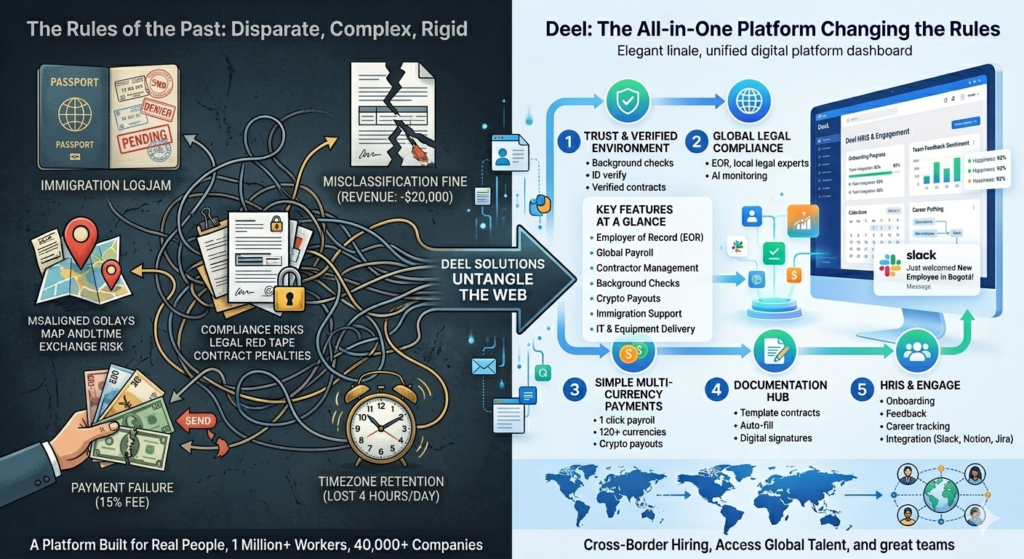
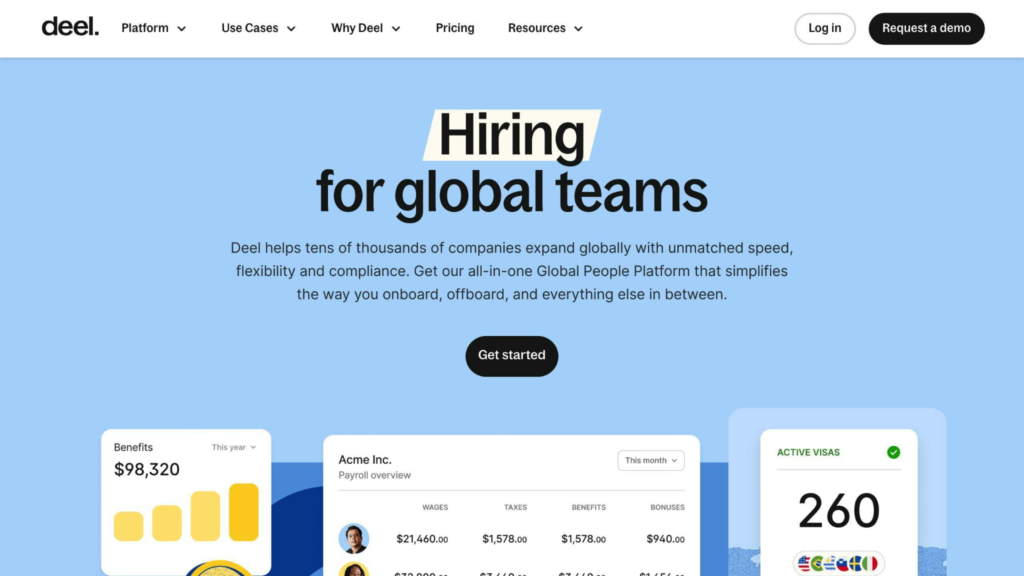
Deel is an all-in-one global HR and payroll platform that enables companies to hire, pay, and manage employees and contractors in 150+ countries without setting up local entities.
It provides:
- Employer of Record (EOR) services
- Global payroll solutions
- Contractor management
- Compliance automation
- Multi-currency payments (120+ currencies)
- HRIS and engagement tools
Companies like Zapier, Reddit, and Intercom use Deel to manage international teams.
Key Statistics About Global Hiring and Deel
- 150+ countries supported
- 40,000+ companies using Deel
- 1M+ workers managed globally
- 283% growth in cross-border AI roles
The 7 Biggest Cross-Border Hiring Challenges (And Solutions)
Cross-border hiring compliance
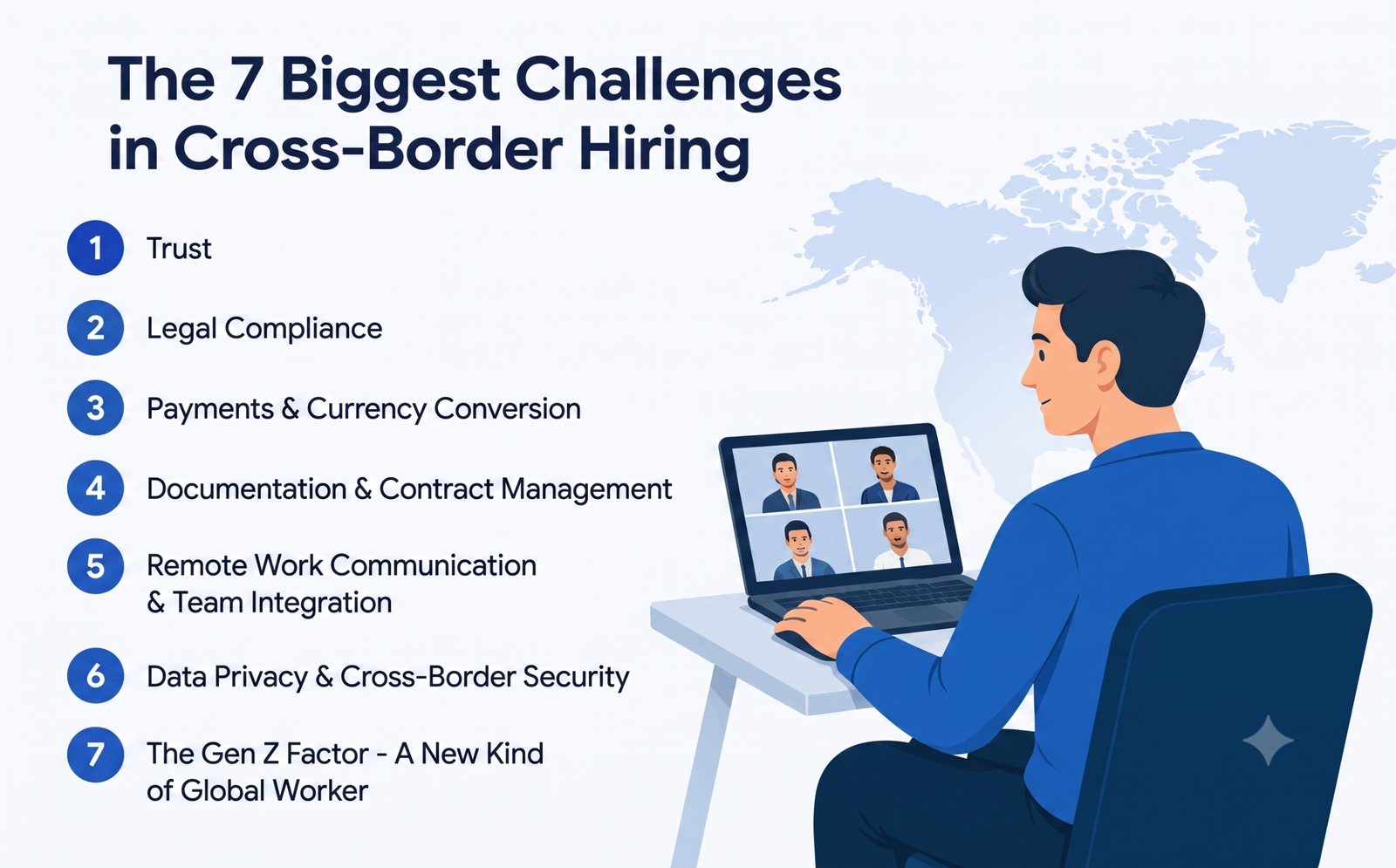
1. Trust Issues in Cross-Border Hiring
Trust is a major challenge in international hiring. Companies worry about verification, while candidates worry about legitimacy and payments.
Solution: How Deel Builds Trust
Deel verifies identities, runs background checks, and ensures reliable cross-border payments creating a secure hiring environment for both parties. Pairing strong verification with effective global talent sourcing strategies helps companies attract the right candidates before the hiring process even begins. Read more: Global Talent Sourcing Strategies for 2026.
2. Legal Compliance and Worker Misclassification in Global Hiring
Each country has different labor laws, tax rules, and compliance requirements. Worker misclassification – treating an employee as a contractor without meeting local legal criteria — can trigger fines upward of $20,000 per incident. Staying on top of statutory compliance across jurisdictions is one of the most demanding aspects of international hiring compliance..
Solution: Deel Employer of Record (EOR)
Deel acts as a legal employer through its EOR services and ensures cross-border hiring compliance across jurisdictions using local experts and AI monitoring. For a thorough breakdown of what global compliance involves, BambooHR’s global hiring compliance guide is a useful resource; nearly two-thirds of organizations cite compliance as their biggest challenge in managing international payroll.
3. Global Payroll and Multi-Currency Payments
International payments involve delays, fees, and exchange rate risks. Managing global payroll manually across multiple countries is not only time-consuming — it’s a major compliance risk. Learn more about what a solid global recruitment strategy looks like when payments are part of the equation.
Solution: Deel Global Payroll System
Deel supports 120+ currencies and multiple payment methods like bank transfer, PayPal, Wise, and crypto. For a deeper look at how leading platforms are reshaping payroll for distributed teams, read Mavenwit’s analysis: The Future of Payroll: Why Deel Is Leading the Charge for Global Teams.
4. Documentation and Contract Management in International Hiring
Managing contracts, tax forms, and compliance documents manually leads to errors. This is especially challenging for businesses that also rely on outsourcing & offshoring as part of their workforce model.
Solution: Automated Contract Management
Deel centralizes documentation with legally compliant templates and e-signature workflows, reducing errors and accelerating onboarding.
5. Remote Team Communication and Integration Challenges
Managing global remote teams across time zones affects productivity and retention. Cross-border hiring introduces real communication overhead that, if left unmanaged, leads to misalignment and high turnover.
Solution: Deel HRIS and Engagement Tools
Deel provides onboarding workflows, Slack and Notion integrations, and employee engagement tools. Pairing these with strong AI-assisted recruiting practices can dramatically reduce time-to-hire and improve candidate quality from the outset. Read more: AI-Powered Recruiting Tools Reshaping Global Hiring
6. Data Privacy and Security in Global Hiring
Handling employee data across regions involves GDPR and a patchwork of other regional regulations. International hiring compliance creates real exposure for companies that lack airtight data governance.
Solution: Secure Global Compliance Infrastructure
Deel ensures data protection with GDPR compliance, role-based access controls, and enterprise-grade secure systems — so sensitive employee data is protected in every jurisdiction.
7. Gen Z Workforce Expectations in Remote Hiring
Gen Z expects flexibility, transparency, and digital-first tools. This demographic is reshaping what international hiring looks like and companies that do not adapt will struggle to access this growing segment of the global talent pool.
Solution: Modern Workforce Experience
Deel offers self-service portals, flexible payment options, and clear digital contracts that meet the expectations of today’s distributed workforce.
Real-World Example: How a SaaS Company Solved Cross-Border Hiring in 90 Days
A mid-size SaaS company headquartered in Austin needed to hire senior engineers in Poland, Brazil, and the Philippines simultaneously. Without a legal entity in any of those countries, the traditional route would have meant months of setup and six-figure compliance consulting fees.
By using Deel’s EOR services, the company onboarded all three hires within 30 days, paying each in their local currency with zero wire fees. Compliance including local contracts, tax registrations, and statutory benefits was handled entirely by Deel’s local legal partners.
The result: $180,000 saved in entity setup costs, a 60% reduction in onboarding time, and zero compliance incidents in year one. This is the practical upside of a well-executed global recruitment strategy — speed, cost savings, and legal certainty.
Cross-Border Hiring: Traditional Approach vs. Using an EOR Platform
| Factor | Traditional (DIY) Approach | EOR Platform |
| Time to hire | 3–6 months (entity setup) | Days to weeks |
| Compliance risk | High — in-house legal burden | Low — local experts handle it |
| Worker misclassification | Common risk | Eliminated by EOR structure |
| Global payroll processing | Manual, error-prone | Automated, multi-currency |
| Upfront cost | $50,000–$200,000 per country | Flat monthly fee per worker |
| Scalability | Slow | Near-instant in 150+ countries |
Benefits of Using Deel for Cross-Border Hiring
Why Companies Choose an EOR for International Hiring
- Hire globally without setting up legal entities
- Ensure international hiring compliance automatically
- Simplify global payroll across 120+ currencies
- Manage contracts and documentation in one platform
- Eliminate worker misclassification risk
- Improve employee experience for distributed teams
Key Features of Deel Global Hiring Platform
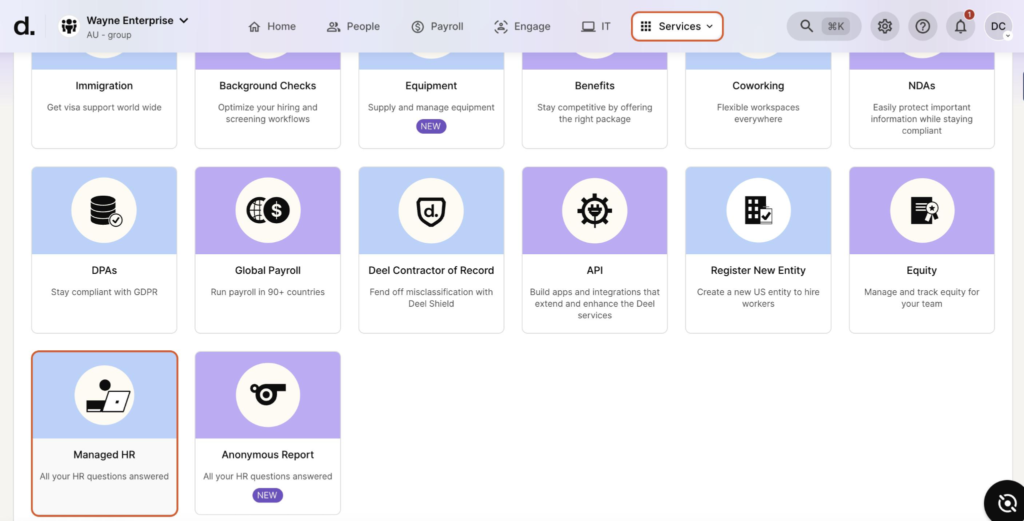
- Employer of Record (EOR)
- Global payroll
- Contractor management
- Multi-currency payments
- Compliance automation
- HRIS and engagement tools
Why Cross-Border Hiring Is the Future of Work
Building a Global Talent Pool: What the Data Shows
Global hiring allows companies to access top talent regardless of geography, reduce hiring costs by tapping into competitive labor markets, build remote-first teams that scale faster internationally, and drive diversity of perspective across the organization. Deel’s 283% growth in cross-border AI roles in 2025 reflects how quickly this model is becoming the default for high-growth companies.
However, success depends on solving the operational challenges outlined above. Companies looking to build truly distributed teams should develop a clear understanding of how to hire employees internationally — including entity strategy, payroll infrastructure, and global HR platform selection — before committing to a model. See also: How to Hire International Employees: A Step-by-Step Guide.
Conclusion: Best Solution for Cross-Border Hiring Challenges
Cross-border hiring offers massive strategic advantages — access to global talent, cost efficiency, and faster scaling — but it comes with real operational challenges including compliance, payroll complexity, worker misclassification risk, and communication overhead.
Deel solves these problems with a unified platform operating in 150+ countries, eliminating the need for local entities and making international hiring compliance a manageable, automated process rather than a legal minefield.
If your company wants to scale globally, using a global HR platform like Deel is not just convenient, it is essential.
FAQs About Cross-Border Hiring
What is cross-border hiring?
Cross-border hiring is the process of employing talent from different countries without geographical restrictions. It typically involves international recruitment, global payroll, and compliance with local labor laws in each jurisdiction where workers are based.
What is an Employer of Record (EOR)?
An Employer of Record is a service provider that legally employs workers on behalf of a company in another country. The EOR handles payroll, statutory benefits, and local compliance, while the client company retains day-to-day management of the worker eliminating the need to establish a local legal entity.
What is worker misclassification and why does it matter?
Worker misclassification occurs when a company incorrectly classifies an employee as an independent contractor. This can trigger fines, back-tax liability, and reputational damage. EOR platforms like Deel eliminate this risk by ensuring every worker is engaged under the correct legal classification in their home country.
How does Deel handle global payroll?
Deel processes payroll in 120+ currencies and supports multiple payment methods globally, including bank transfer, PayPal, Wise, and cryptocurrency. It automates tax calculations and deductions in compliance with local law in each supported country.
How is cross-border hiring different from domestic hiring?
Domestic hiring operates within a single legal, tax, and payroll framework. Cross-border hiring introduces multiple overlapping jurisdictions each with its own employment law, minimum wage rules, benefits mandates, and tax obligations. Without the right infrastructure, typically an EOR or a robust global HR platform, the compliance burden can be overwhelming for HR teams.
Affiliate Disclaimer
This post contains affiliate links. We may earn a commission at no extra cost to you.
