


Introduction: The Turnover Problem Nobody Wants to Talk About
Turnover through better hiring is one of the most overlooked fixes in HR — and everyone can relate to this experience. You have a valuable member who gives notice. You struggle to take care of his or her responsibilities, begin the recruitment process anew, and hope you did everything right. Months go by. You hire someone else. But it happens once more.
Employee turnover is a classic case of a problem that keeps on recurring because companies try to solve it using the wrong strategy. Employee surveys, increased salaries, improved benefits. These measures are taken after the event, not before.
The harsh reality is this. In most cases, the real problem does not arise at the moment an employee gives notice but before – often even during the recruitment process.
It’s important who you hire, but even more so how you do it. Companies that don’t have high turnover rates aren’t just paying people more or giving them a free lunch. They’re doing things right from the start. This blog is all about that. It’s not a solution or a to-do list. It’s just the truth about how the hiring process is flawed and what needs to be done differently.
Why Bad Hires Are More Expensive Than You Think
It makes sense to begin with the numbers because they tend to catch people’s attention easily. On average, replacing an employee could cost somewhere between one-half and two times his or her yearly pay. In some cases, the figure is even higher, especially if you consider the role of the replaced employee.
But that is only half of the story. There is the hidden price of it all.
With departures come institutional memory, relationship capital and context that cannot be documented. Building up again takes months, even years, for new hires. More importantly, in the meantime, there are greater burdens on the team than there need to be.
In small companies, one poor hiring decision in a critical position will stall the whole department. In large companies, continuous high levels of turnover create a sense of instability among employees, leading to more of the same. Good hiring decisions don’t simply save money in one area; they save everything else downstream — which is exactly why turnover through better hiring works as a long-term cost strategy, not just a quick fix.
The Real Reasons People Leave (And Why Hiring Gets the Blame)
Most people don’t leave jobs for one reason alone. It’s typically a gradual process, which begins with disappointment and unmet expectations and then leads to reaching out to recruiters on LinkedIn.
Some of the most common complaints people have about the job they quit? Poor management. Lack of opportunities for career advancement. Not being appreciated. No alignment with the overall strategy of the organization.
And here’s something to think about. Most, if not all, of these things stem from a problematic recruitment process.
When someone is hired to perform duties they were not initially aware of, dissatisfaction sets in immediately. When the person hired for the manager position has technical skills but not leadership skills, they will not be able to manage successfully. And when the culture is not considered during the recruitment process, the result is hiring people who are technically competent but culturally unfit.
Recruitment sets expectations. It determines what kind of working relationships managers and employees will form right from the start.
If turnover is your problem, the answer lies in turnover through better hiring — looking at its causes long before any actual hiring takes place.
Hiring for Fit, Not Just Skill
This will make some people queasy. Recruitment based on “fit” does have a bad name. Fair enough. But if fit is recruiting individuals because they resemble those already employed by the organization, then we’ve lost the plot. Such an approach will stifle innovation and diversity of thought. Fit isn’t fit; it’s conformity.
Fit can mean many things, including having common values, work styles, motivating factors, and preferred environments.
It’s possible to recruit highly talented people whose ideal conditions consist of chaotic environments when your existing team functions in structured surroundings. This doesn’t have anything to do with lacking certain skills; it just sets up the wrong expectation of each other.
Checking true fit requires posing better questions. Like not, “where do you see yourself in five years?” because we all have an answer to that one. More like, what is your preferred method of receiving feedback? How would a bad week at the office present itself to you? Tell me about a place where you’ve been happy working – what was it?
Because those questions tell us something. Not everything. But something.
Hiring for both fit and ability does not entail lowering your standards — this is what turnover through better hiring really means. It involves elevating them.
Finding someone who is capable of doing the job and who actually wants to do it in the way that it has to be done, in the context that you really live in.
Writing Job Descriptions That Actually Attract the Right People
“Job descriptions are typically wish lists,” according to David Spinks. “They list every possible responsibility of the role, every conceivable qualification needed, and then some standard language about company culture that literally tells us nothing.”
So you end up getting resumes from individuals who simply don’t understand the role. And then you don’t know why your hiring didn’t work out.
The job description is very simple in its construction. In addition to defining what the position entails, it must accurately convey what it entails daily; this goes beyond merely stating responsibilities, but includes mentioning ambiguities, speed, reporting structures, etc., while being descriptive enough so that unqualified individuals recognize the job as such.
This is very valuable information. If you are clear about the constant switching back and forth and dealing with stakeholders required by the position, those needing long blocks of uninterrupted time to work effectively will likely move elsewhere. And this is a very good thing.
The clarity of job descriptions indicates something about your organization as well.
It lets others know that you have considered the position carefully and understand the role, and are thus hiring for the role rather than just any employee.
And this is very important to the best applicants you want to attract.
The Interview Process: Where Most Companies Get It Wrong
Interviewing processes are flawed in most companies. Not totally, but certainly enough to make you wonder.
It usually looks like this. A couple of rounds of interviews. Perhaps some technical assessments. If anyone remembers references. And then a gut instinct. Offer out.
The issue is that the interviewing process isn’t designed to collect accurate data for a company, but rather to maximize candidates’ ability to present themselves positively.
Candidates can prepare and be trained in the art of interviewing. They know what sounds impressive. Interviews can turn into performances.
That’s where structured interviewing comes into play. Structured interviews provide much more meaningful data than unstructured ones. When all your candidates answer the same critical questions, in the same way, in the same order, and get scored on the same criteria, you get comparable information. Bias becomes a lot harder. You make it easier to discuss candidates rather than exchange opinions.
Behavioral interviews are much more informative than situational ones. Asking about an experience managing a tough stakeholder provides different insight than asking how they would manage a tough stakeholder. One relies on personal memory while the other creates a made-up story.
Work samples can also be very useful. These provide more information about the candidate that simple dialogue alone cannot convey. Work samples can be difficult to put in place for any number of positions. When implemented, however, they can prove incredibly useful.
References are another great source of information. Do not simply ask for references, but take the time to actually contact them. Ask very direct questions. “What qualities should a manager have to get the best performance out of this candidate?” can yield some very important information.
Onboarding Is Still Part of Hiring
And here’s where companies get it wrong. They believe the entire process ends at offer acceptance. Wrong.
The first 90 days will decide the success of the hire. Even more than interviews. Even more than assessments. The moment a person truly proves whether he or she was indeed the right choice, and the company fulfills its end of the bargain.
A bad onboarding experience is one of the most consistent causes of premature turnover. Individuals who feel confused, unsupported, and out of place during their first months of employment are more prone to leaving after a year than not. Or worse, staying longer and disengaging mentally long ago.
Onboarding isn’t just setting up computer accounts and filling out forms. Good onboarding takes deliberate effort. It familiarizes employees with the culture, the staff members, the unwritten policies that affect them each day, and creates a foundation of reasonable expectations and safe spaces to air grievances.
Consider onboarding as the final step in the hiring process. It ensures all that investment goes to good use.
Using Data to Hire Smarter
For most organizations, most of their hiring decisions are based on instincts. Nothing wrong with that. But judgment is important. Context is important. Instincts alone, without data, will lead you into patterns that were never intended.
The good news is that data is available like never before in history. Time-to-hire metrics. Acceptance of offers. Places where candidates lose interest in the process. Sources that provide candidates who remain in the job long-term. Interviewers who consistently hire great talent and keep them.
And this is the key – understanding the common denominators among those interviewers who hire great talent and retain them over time is valuable. Are there particular aspects they look for that others miss? Monitoring the success rate and retention of hires after 6 and 12 months of employment, and then going back and tracing it to your hiring process, reveals the trends very quickly. You don’t need to guess anymore where your process excels and where it fails.
This doesn’t take anything away from the judgment. While data shows you what happened, judgment lets you understand why.
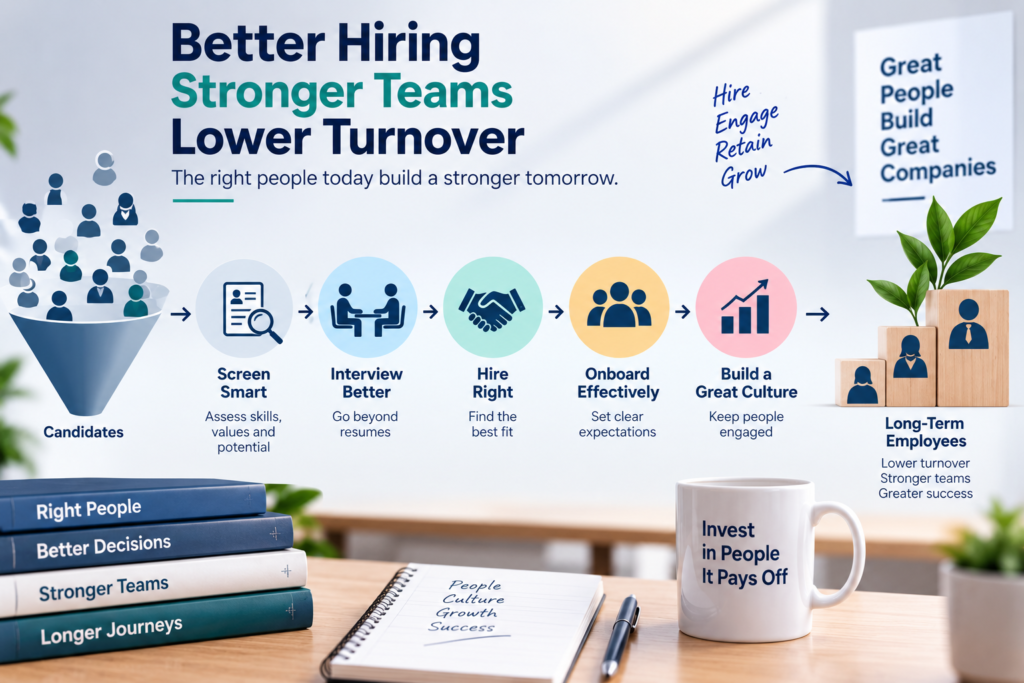
Building a Culture That Keeps People Before They Think About Leaving
Hiring better gets people in the door. Culture keeps them there.
And culture isn’t a set of values on a website. It’s what happens in meetings. How feedback is given. Whether people feel safe raising problems. Whether managers actually develop their teams or just manage their output.
The relationship between hiring and culture is circular. A strong culture attracts people who fit it. A bad hire erodes it. Which is why getting the hire right matters beyond the individual. can poison a team dynamic faster than most leaders realize. Organizations with low turnover tend to have a few things in common. Managers who are genuinely invested in their people’s growth. Clarity about what success looks like in each role. A feedback culture where problems get surfaced early instead of quietly building. And some level of psychological safety. The sense that it’s okay to be honest. None of that happens without intention. And all of it starts with who you hire into leadership positions.
Which brings everything back to the beginning. Turnover through better hiring starts with culture — if you want to build a culture that retains people, hire people who build that culture. Especially at the top.
How Turnover Through Better Hiring Creates Long-Term Stability
Turnover Through Better Hiring starts with understanding that employee retention is influenced long before an employee joins the organization. When companies define roles clearly, evaluate candidates against consistent criteria, and consider both skills and cultural alignment, they create stronger foundations for long-term employment. Turnover Through Better Hiring is not simply about reducing the number of resignations; it is about making better hiring decisions that match employees with roles where they can succeed.
A strong recruitment process also helps organizations identify candidates who understand the expectations of the position before accepting an offer. This transparency can reduce misunderstandings and prevent employees from discovering after joining that the role is very different from what they expected. In this way, Turnover Through Better Hiring becomes a proactive approach rather than a reaction to employee departures.
Organizations can also strengthen retention by connecting recruitment with effective onboarding, performance expectations, and career development. When new employees receive the right support from the beginning, they are more likely to become productive and feel connected to the organization. Professional recruitment services can also help companies improve candidate screening, evaluation, and hiring processes. Ultimately, Turnover Through Better Hiring helps businesses build more stable teams, reduce repeated recruitment costs, and create a workforce that supports sustainable growth.
Making Better Hiring Decisions for Long-Term Retention
Organizations that want to reduce employee turnover need to look beyond simply filling open positions. Turnover Through Better Hiring requires a more thoughtful approach to how candidates are evaluated, how expectations are communicated, and how employees are supported after joining. A strong hiring strategy helps companies identify candidates whose skills, goals, working style, and expectations match the actual requirements of the role. This creates a stronger connection between the employee and the organization from the beginning.
Another important part of Turnover Through Better Hiring is maintaining transparency throughout the recruitment process. Candidates should understand their responsibilities, performance expectations, workplace environment, and potential growth opportunities before accepting an offer. When organizations provide accurate information instead of presenting an unrealistic picture of the role, employees are more likely to enter the company with realistic expectations.
Companies can also use feedback from previous hiring outcomes to improve future decisions. Reviewing why employees leave, which roles experience the highest turnover, and which hiring sources produce long-term employees can reveal valuable patterns. By continuously improving recruitment practices based on these insights, businesses can make more informed hiring decisions.
Ultimately, Turnover Through Better Hiring is about creating a connection between recruitment and retention. When companies hire carefully, communicate honestly, and support employees from day one, they create stronger teams and a more stable workforce.
Conclusion: Retention Starts Before the Offer Letter
Turnover will never be zero. People’s circumstances change. Careers evolve. Life happens. Some movement is healthy and normal. But chronic, preventable turnover? That’s a hiring problem wearing a natural costume.
The organizations that solve it aren’t doing anything mystical. They’re writing honest job descriptions. They’re interviewing with structure and intention. They’re actually calculating fit alongside skill. They are treating the process of onboarding very seriously. They’re tracking what works and adjusting when it doesn’t. And they’re hiring for the culture they want to build, not just the gap they need to fill.
That’s the shift — turnover through better hiring means moving from reactive to intentional, from filling roles to building teams.
It takes longer upfront. It requires more honesty, both about what a role is and what your organization actually is. But it pays off in ways that are genuinely hard to measure. Stability. Trust. Momentum. The kind of team that makes the work possible.
Retention doesn’t start with a retention strategy. It starts before the first interview. Before the job description goes live. It starts with deciding that hiring deserves the same rigor and seriousness as every other decision that shapes where the organization is headed.
Get turnover through better hiring right, and everything else gets easier.
CTA
Looking for further insight into recruitment, business strategy, and digital transformation?
👉 Read more here: https://www.mavenwit.com
Frequently Asked Questions (FAQ)
Q1: What is the single biggest hiring mistake that leads to turnover?
Hiring for skill while ignoring fit. Someone can be technically excellent and still be completely wrong for the environment, the team, or the role as it actually exists. That mismatch surfaces fast. And it costs everyone.
Q2: How early in the hiring process should culture fit be assessed?
From the very first interaction. Not just in a formal culture interview round. The way a candidate communicates throughout the process tells you a lot. So does the way your team communicates with them. Fit isn’t a checkbox. It’s a thread you follow from the first email to the final interview.
Q3: Does improving onboarding really reduce turnover?
Yes. Significantly. Research consistently shows that employees who experience structured, intentional onboarding are more likely to stay past the one-year mark. It’s one of the highest-ROI investments an organization can make in retention.
Q4: How do you measure whether your hiring process is working?
Track new hire retention at 6 and 12 months. Ask for honest feedback from new hires at 30, 60, and 90 days. Look at which sourcing channels produce hires that stay. Compare notes across interviewers. The data is there. Most organizations just aren’t looking at it consistently.
