

You Spent 3 Days on that Resume. An Algorithm junked it in 0.3 Seconds.
Nobody warned you about this part.
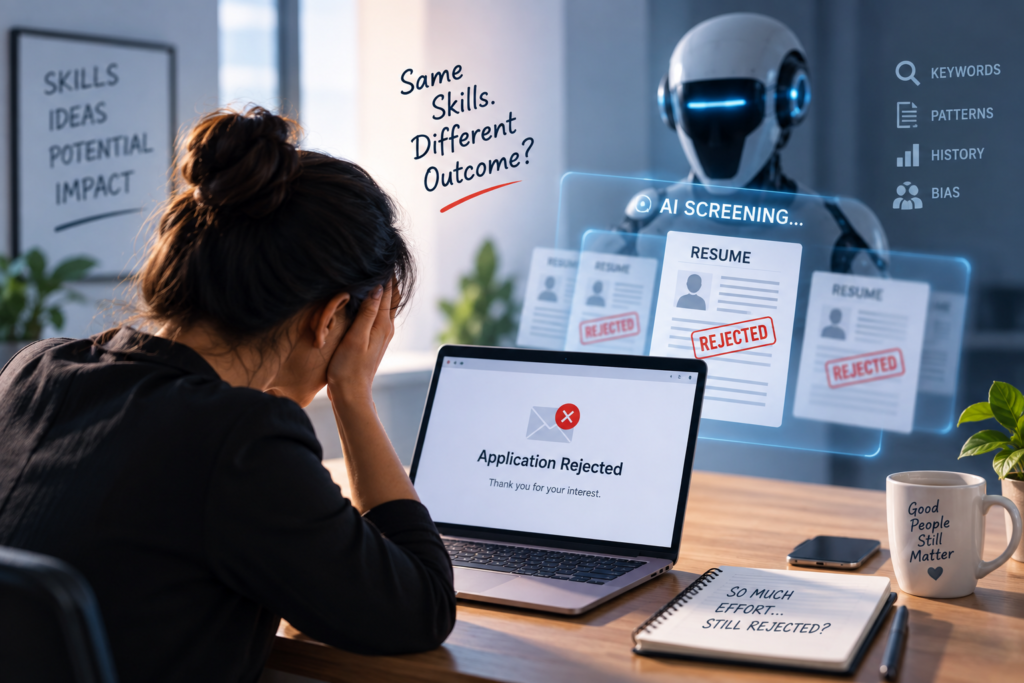
There are 4 hidden stages where AI bias can quietly kill your hiring chances — and most candidates never even know they’ve been filtered out. You stayed up until 1 AM tweaking your resume. You researched the company. You personalized your cover letter so much that it barely resembled the template you started with. You hit submit, felt that little rush of hope, and then got an automated rejection before you’d even made yourself a coffee.
No human looked at your application. Not one. A piece of software ran your name through a filter, decided you weren’t a keyword match, and moved on. You never had a chance to make a case for yourself.
This isn’t a rare glitch. It’s Tuesday. It’s how most mid-to-large companies now handle the early stages of hiring, and the majority of candidates have zero idea it’s happening to them.
As a hiring company, we think that’s a problem worth talking about honestly. So let’s talk.
What Are the 4 Hidden Stages of AI Hiring Bias?
People hear “AI bias” and immediately picture some sinister robot making racist decisions on purpose. That’s not what’s happening, and honestly, the reality is messier and harder to fix than that.
Here’s the actual picture: Companies collect years of hiring data. Who applied, who got interviewed, who got hired, and who got promoted. Then they feed that data into a machine learning model and ask it to find patterns. The model does exactly that. It finds patterns.
The problem is that those patterns reflect the decisions humans already made, and humans, as a species, have a pretty well-documented history of hiring people who look, talk, and went to school like themselves. So when the model learns from that data, it learns those preferences too.
It doesn’t know they’re biases. It just knows they’re patterns.
That’s AI bias. It’s not spite. It’s inheritance. The machine inherits the prejudices of the data it was raised on, the same way kids pick up attitudes from the environment they grew up in. And then it scales those prejudices to a hundred thousand applications a year.
The 4 Hidden Stages Where AI Bias Shows Up?
Everywhere. Genuinely, unfortunately everywhere.
And the worst part? Most of it happens before a single human being has even opened your file.
Let me walk you through each of the 4 hidden stages, because once you see them, you can’t unsee them.Let me walk you through each stage because once you see it, you can’t unsee it.
Stage 1:The Resume Screen: This Is Where Most People Get Buried
Think about what happens the moment you hit submit on a job application at any company with more than a few hundred employees. Your resume doesn’t land on a recruiter’s desk. It lands in a queue. And before any human touches that queue, software goes through it first.
Applicant Tracking Systems (ATS), if you want the industry term, scan your resume for signals. Keywords from the job description. Formatting patterns. Job titles that match what previous hires had. Company names the model recognizes. It’s looking for a profile it’s seen before, and if your resume doesn’t match that profile closely enough, it gets deprioritized. Sometimes outright removed.
You don’t get a “close but no” message. You just never hear back.
Now think about who that hurts the most. The person who took two years off to care for a sick parent, that gap in their employment history looks like a red flag to the algorithm, even if they’re the most qualified candidate in the pool. The woman who stepped back from her career for a few years to raise kids and is now ready to return – flagged. The immigrant whose resume follows formatting conventions from their home country doesn’t match the template—filtered out.
These aren’t edge cases. These are real people with real skills getting removed from consideration by software that was never designed to understand contextbut only to match patterns.
Stage 2: Job Description Language: The Bias Starts Before You Even Apply
Here’s something that doesn’t get talked about enough: by the time you read a job posting, the bias may have already started working against you.
A lot of companies now use AI to write or at least optimize their job descriptions. The logic makes sense on the surface: use data from past successful hires to figure out what language attracts strong candidates. Feed that into the model. Let it write the posting.
The problem is that “strong candidates from the past” often means something pretty specific. If a company spent the last decade hiring mostly men for engineering roles, the AI looks at that history and learns without being told explicitly what kind of language those hires responded to.
Words like “dominant,” “competitive,” and “aggressive.” These aren’t neutral descriptors. Research consistently shows they pull more male applicants and actively discourage women from applying.
Nobody sat down and said, “Let’s write a job description that filters out women.” The modelis just optimized for what worked historically. And what worked historically was shaped by decades of biased hiring decisions.
So before you’ve written a single word of your cover letter, the job posting itself may have been designed accidentally, algorithmically, to appeal to a specific type of person. And if that’s not you, you might not even bother applying.
Stage 3: Video Interview AI: Probably the Most Uncomfortable One to Talk About
Some companies now use AI to analyze recorded video interviews. Not just to store them to score them. The software watches your interview and evaluates your word choice, your tone of voice, your facial expressions, your eye contact, and even the pacing of how you speak. It produces a score. That score influences whether you move forward.
Take a second and really think about what that means.
An algorithm is watching your face and deciding whether the way you communicate makes you a good fit for the job.
The issue isn’t the technology itself; it’s what the technology was trained on. These models learn what “good communication” looks like from the data they’re given. And that data reflects a pretty narrow slice of how humans actually communicate.
If you’re neurodivergent, you might naturally make less eye contact. That’s not a communication failure; that’s just how you’re wired. The AI doesn’t know that. It sees low eye contact and docks points.
If English isn’t your first language, your cadence and rhythm when you speak might differ from the baseline the model was trained on. You might pause differently, emphasize differently, and structure sentences differently. None of that means you can’t do the job. But the model flags it anyway.
If you grew up in a culture where holding sustained eye contact with a senior person is considered disrespectful, not a sign of confidence, you’ve spent your whole life learning to communicate respectfully in a way that the algorithm now reads as evasive.
The software cannot tell the difference between “this person communicates poorly” and “this person communicates differently from what I was trained to expect.” To the model, those look identical.
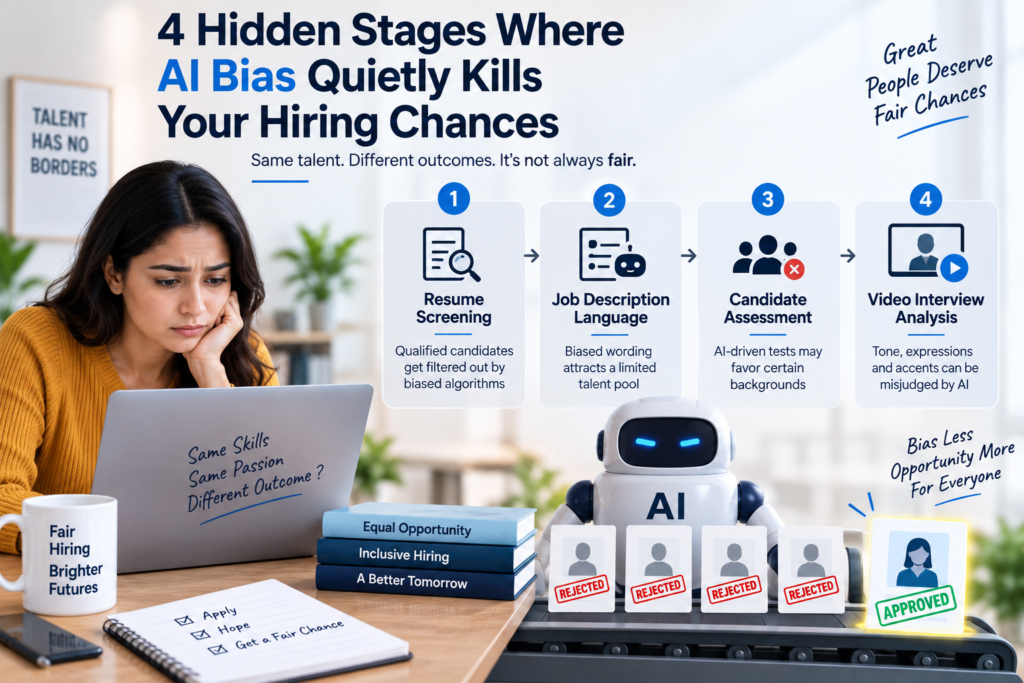
Stage 4: Culture Fit Scoring: The Sneakiest One of All
“Culture fit” sounds harmless. It sounds like companies just want to make sure you’ll get along with the team. And sometimes that’s genuinely what it means.
But when AI gets involved in measuring culture fit, it turns into something else entirely.
Here’s how it works. A company builds an AI model based on the traits of their existing employees, the people who are already there, already succeeded, and already fit in. The model learns what those people have in common. Then it scores incoming candidates on how closely they match that profile.
On paper, that sounds reasonable. In practice, it’s a machine learning to clone your existing workforce.
If your current team mostly went to the same ten universities, the model learns to favor candidates from those schools. If your employees mostly grew up in similar ZIP codes, followed similar career trajectories, and had similar extracurricular activities, the model picks all of that up and starts treating it as a signal of quality. Not because those things actually predict job performance. Because they predict similarity.
And “similar to people we already hired” is not the same thing as “qualified.” It just feels that way to the algorithm because in its training data, similarity and success were always correlated.
This is how companies end up with workforces that keep looking the same year after year despite genuinely trying to hire more diversely. The AI they’re using to help is actively working against that goal, and because the bias is buried in a scoring model rather than visible in a human decision, nobody notices until someone goes looking for it.
Who the 4 Hidden Stages Hurt Most
Not everyone equally. That’s the thing about systemic bias; it compounds existing disadvantage.
Women get filtered out at higher rates in fields where AI is trained on male-dominated hiring histories. Amazon’s now-infamous AI recruiting tool, which they built internally and then quietly scrapped in 2018, actively penalized resumes that included the word “women’s.” Women’s chess club. Women’s business network. All of it flagged as a negative signal. Nobody programmed that in deliberately. The model picked it up from historical data showing that resumes without that word led to more hires.
People of color face different but equally real barriers. When an AI trains on data from companies that historically hired fewer people of color for certain roles, it bakes in that underrepresentation as a baseline. Candidates who don’t match historical patterns get lower scores, and nobody reviewing the final shortlist sees the people who were quietly removed upstream.
Older workers get hit too. AI systems that were optimized around recent graduates because recent hires were mostly recent graduates learn to flag long careers as a mismatch rather than an asset. An experienced professional with 20 years of expertise can score below a new grad because the model wasn’t designed to value depth, only familiarity.
And people with disabilities often run into serious trouble with video interview AI specifically. The systems weren’t built with them in mind.
What Does Getting This Right Actually Look Like?
AI can reduce hiring bias if it’s used correctly. Human interviewers are genuinely and inconsistently affected by hunger, by mood, and by whether the candidate reminded them of someone they like or don’t like. Structured, well-audited AI can remove some of that noise.
But “used correctly” requires actual effort. It means:
- Auditing AI tools for different impacts before deploying them, running the model on diverse test datasets, and checking whether any group is systematically scored lower.
- Demanding transparency from vendors about how their models were built and what protections are in place.
- Keeping humans in the loop at every stage where a real person’s opportunity is on the line.
- Designing job descriptions with intentional language review, not just letting an AI optimize for “what worked before.”
- Tracking the demographic composition of your funnel at every stage so you can see where the drop-offs are happening because if your applicant pool is diverse but your interview pool isn’t, something in between is doing damage.
- Being honest with candidates about when and how AI is being used to evaluate them. That’s both ethically right and legally required.
How the 4 Hidden Stages Can Affect Hiring Decisions
Understanding the 4 Hidden Stages of AI hiring bias can help both candidates and employers recognize where unfair filtering may happen during recruitment.
These 4 Hidden Stages are not always visible because many decisions take place behind automated systems before a recruiter reviews an application. A candidate may have the right experience and qualifications but still lose an opportunity because an AI system interprets certain information differently from a human recruiter.
The 4 Hidden Stages can influence how resumes are ranked, how job descriptions attract specific types of applicants, how interview responses are evaluated, and how cultural similarity is measured. Recognizing these 4 Hidden Stages gives recruitment teams an opportunity to review their processes more carefully and identify potential gaps in fairness.
For candidates, understanding the 4 Hidden Stages can also make it easier to prepare resumes, applications, and interviews in ways that communicate their real skills clearly. Most importantly, businesses should not treat automated scores as the final measure of a candidate’s potential.
Human oversight, regular audits, transparent evaluation criteria, and inclusive recruitment practices can help ensure that technology supports better hiring decisions rather than quietly creating new barriers. By examining the 4 Hidden Stages throughout the hiring journey, companies can build a recruitment process that is more transparent, consistent, and focused on genuine qualifications.
Conclusion
AI didn’t invent hiring bias. Humans managed to build spectacularly biased hiring systems long before any of this technology existed. What AI did was take that bias and put it on autopilot faster, on a larger scale, and invisible to the people it’s affecting.
The machine isn’t the villain. The lack of accountability around the machine is.
Every candidate who sends in an application deserves to have it evaluated fairly, not filtered out by a system that learned to prefer people who look like last year’s hires. That’s the standard we hold ourselves to, and it’s the standard we think every company in this space should be held to.
Fixing this isn’t optional anymore. For a lot of companies, it’s becoming a legal obligation. But more than that, it’s just the right thing to do.
Your next great hire is being filtered out right now by one of these 4 hidden stages. Let’s fix that together. Get in touch with NonStop Hiring to build a recruitment process that actually finds the right people.
Frequently Asked Questions
1. How do I actually know if an AI screened my resume?
You often can’t tell for certain. But if you applied online to a company with hundreds of employees and got a rejection within a few hours (sometimes minutes), AI was almost certainly involved at some point. You’re allowed to ask companies directly what tools they use in their hiring process.
2. What can I do to make my resume more AI-friendly without sounding robotic?
Try to mirror the language used in the job description naturally and not awkwardly. Use standard section headers like “Experience” and “Education.” Avoid tables, columns, or graphics in your resume if you’re applying through an online portal, since ATS software often can’t read them properly. But don’t stuff your resume with keywords you can’t back up. Interviewers notice.
3. Do small companies use AI screening too?
It’s a common assumption that only big corporations use AI screening, but that’s changing fast. Small businesses and startups are increasingly turning to affordable AI-driven ATS platforms simply because hiring teams get overwhelmed quickly. If you applied to companies that use an online application portal, there’s a decent chance AI touched your resume at some point, regardless of the company size.
